
Sustainability Policy / Sustainability Promotion System Materiality (Important Issues)
Materiality Identification Process
In 2020, SHR has identified our materiality in accordance with the following process, with the aim of promoting more concrete initiatives for sustainability through our business activities. As the environment surrounding stakeholders and SHR is changing, the Sustainability Committee will review the materiality at least once a year even after it has been identified. By pursuing the sustainability of SHR in a manner that meets the demands of society, we will fulfill our responsibilities towards the sustainable growth of both society and SHR.
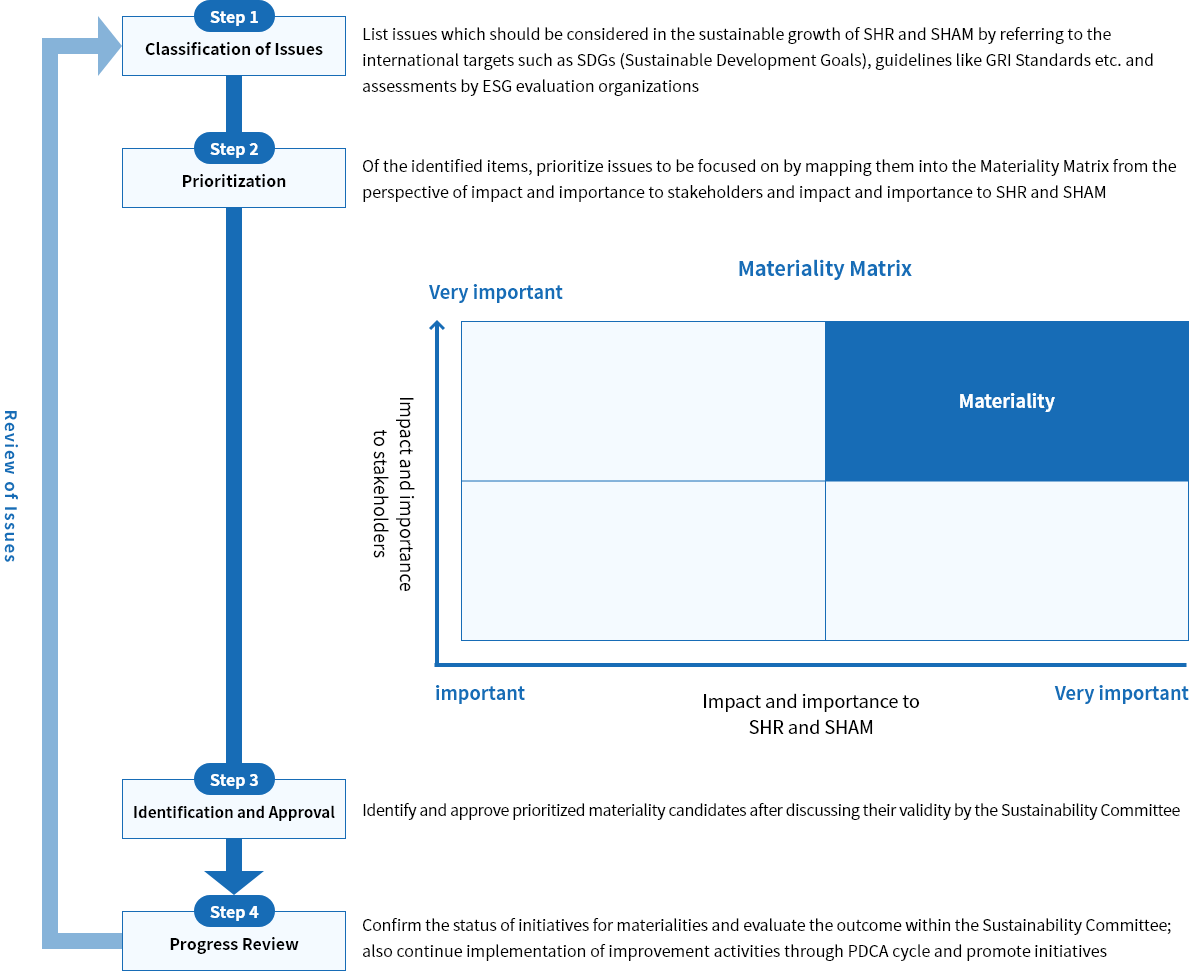
Materiality
SHR believes that sustainable growth in our business activities is built on a solid foundation of a sustainable society, and recognizes that in order to continue providing "Prime Properties", which SHR focuses on as an investment strategy, it is necessary to carry out initiatives based on the guidelines of solving issues to build a sustainable society through business activities. Based on this recognition, SHR has identified nine materialities (important issues) and set targets (KPIs) as indicators to resolve each of them. In light of the SDGs adopted by the United Nations in 2015, we will pursue mutual sustainability of both society and SHR by promoting efforts to resolve these material issues.
Materiality of SHR
This table can be scrolled sideways.
| Materiality | Reasons for Selecting Materiality Issues | Targets (KPIs) | Related Pages |
Related SDGs | |||||||
|---|---|---|---|---|---|---|---|---|---|---|---|
| Environment | Promoting Response to Climate Change |
|
|
Page linked |
|
||||||
| Reduce 10% energy consumption intensity by 2028 compared to 2018 | |||||||||||
| Conservation of Natural Capital, Coexistence of Humankind and Nature, and Activities for the Resources Environment | To directly reduce business continuity risks over the long term by preventing the loss of biodiversity, which is a cornerstone of society and the economy. | For properties where regular inspections reveal poor management of planting strips (dead, withered, or overgrown plants), develop improvement measures and corrective action plans. 100% implementation rate as of the end of December each year | Page linked |
|
|||||||
| No increasing waste emission intensity compared to 2018 | |||||||||||
| Reduce 5% water use intensity by 2030 compared to 2018 | |||||||||||
| Investing in Real Estate with Excellent Environmental Performance | To enhance the objectivity and reliability of our environmental impact reduction initiatives and to facilitate improvements for further advancement | Maintain 90% or more of the portfolio with green certification | Page linked |
|
|||||||
| Acquire and keep owning 10 ZEH properties or more by 2030 | |||||||||||
| Collaboration with stakeholders on environmental considerations | Collaboration with stakeholders is essential for promoting and achieving sustainability initiatives | Achieve 70% or more of the portfolio with green lease agreement by 2030 | Page linked |
|
|||||||
| Achieve 50% or more of sustainability finance in interest-bearing debt by 2030 | Page linked |
||||||||||
| Society | Providing Residents and Tenants with Secure and Comfortable Space that Offers Peace of Mind | To maintain and enhance the competitiveness of our properties and stabilize and improve property management performance by improving tenant satisfaction and ensuring safety and security | Tenant satisfaction surveys :Once every three years | Page linked |
|
||||||
| Flood risk surveys : Once a year | Page linked |
||||||||||
| Contributing to Society | To secure long-term social trust and investor returns by coexisting with the local community and contributing to value enhancement, in recognition of the public nature of real estate |
Conducting cleanup activities Introduction of community-oriented infrastructure Participation in local community events in the areas where the properties are located |
Page linked |
|
|||||||
| Creating a Rewarding Workplace | To foster sustainable organizational growth by improving the workplace environment and investing in our people—viewing the talent that supports our asset management operations as human capital that generates corporate value | Total working hours: Average of 162 hours or less per month |
Page linked |
|
|||||||
| Paid leave utilization rate: 70% or more | |||||||||||
| Take-up rate for male childcare leave: 100% | |||||||||||
|
Engagement survey score: eNPS: 60% or more of respondents are passives and promoters |
|||||||||||
| Percentage of female managers: 10% or more by 2030 |
|||||||||||
| Training hours per employee: 20 hours or more per year |
Page linked |
||||||||||
| Governance | Strengthening Corporate Governance System | To ensure the propriety of SHA’s operations and the soundness of its management, to accurately identify various risks inherent in its operations, and to ensure transparency in asset management | Percentage of non-interested parties at the Board of Directors of SHR: 75% or more | Page linked |
|
||||||
|
Compliance training by external experts, etc.: Four times a year Participation rate: 100% |
|||||||||||
| Internal audits: Twice a year | |||||||||||
| Risk management meetings: Twice a year | Page linked |
||||||||||
|
Safety confirmation: Once a year Phishing email training: Once a year |
|||||||||||
| Appropriate Disclosure and Engagement with Stakeholders | To ensure timely and appropriate disclosure, improve the usefulness of diclosures, and build strong relationships with stakeholders based on trust |
Achieve 4 stars in GRESB Real Estate Maintain core A in CDP Climate Change Strengthening engagement through IR meetings with institutional investors and events for individual investors |
Page linked |
|
|||||||